This comprehensive guide covers pitch, scales, rhythm, chords, and form—essential elements for success in the AP Music Theory exam.
I; Fundamentals of Pitch
Understanding pitch is foundational to music theory. Pitch refers to the highness or lowness of a sound, determined by its frequency. The staff, with its five lines and four spaces, visually represents pitch. Clefs—treble, bass, alto, and tenor—assign specific pitches to these lines and spaces.
Notes are symbols representing pitch and duration. Accidentals—sharps (#), flats (♭), and naturals (♮)—alter pitches. Sharps raise a pitch by a half step, flats lower it, and naturals cancel previous alterations. Key signatures, utilizing sharps or flats, indicate consistently altered pitches throughout a piece, streamlining notation. Recognizing these fundamentals is crucial for analyzing and composing music, forming the basis for harmonic and melodic understanding.
II. Major Scales and Key Signatures
Major scales form the bedrock of tonal music. Constructed with a specific pattern of whole and half steps (W-W-H-W-W-W-H), they define a key’s tonal center. Key signatures indicate which notes are consistently sharp or flat within a given key. Sharps are added in fifths (F#, C#, G#…), and the major key is a half step above the last sharp.
Conversely, flats are added in fifths (Bb, Eb, Ab…), with the major key being the penultimate flat. Mastering scale construction and key signature identification is vital. This knowledge allows for quick recognition of tonal context and facilitates harmonic analysis, enabling confident sight-reading and composition.
III. Rhythm and Meter
Rhythm and meter provide the temporal framework for music. Time signatures dictate the number of beats per measure (top number) and the note value receiving one beat (bottom number). Understanding tempo markings—from Grave (slowest) to Allegro (fast)—is crucial for interpreting a piece’s character.
Meter can be classified as simple (beats divided into two) or compound (beats divided into three). Further categorization includes duple, triple, or quadruple meter, based on the number of beats per measure. Accurate rhythmic reading and the ability to identify metric groupings are essential skills for any music theorist.
A. Time Signatures
Time signatures are foundational to understanding rhythmic structure. The upper numeral denotes beats per measure, while the lower indicates the note value receiving one beat. Common time signatures include 4/4 (common time), 3/4 (waltz time), and 6/8 (compound duple).
Interpreting time signatures requires recognizing simple versus compound meters. Simple meters divide the beat into two equal parts, while compound meters divide it into three. Accurately identifying the time signature is vital for correct rhythmic interpretation and performance. Recognizing irregular time signatures is also important for advanced analysis.
B. Tempo Markings
Tempo markings dictate the speed of music, influencing its character and feel. Italian terms are commonly used, ranging from Grave (slowest) to Presto (fastest). Key terms include Largo, Adagio, Andante, Allegro, and Vivace.
Understanding tempo is crucial for accurate performance and interpretation. Metronome markings (beats per minute — BPM) provide precise tempo guidance. Tempo can also be indicated with descriptive terms like “accelerando” (gradually faster) or “ritardando” (gradually slower), adding expressive nuance to the music. Recognizing these markings enhances musical understanding.
IV. Minor Scales and Key Signatures
Minor scales offer a contrasting tonal color to major scales, evoking different emotions. The natural minor scale is derived from the major scale by starting on the 6th degree. The relative minor shares the same key signature as its relative major – find it by going down three half steps.
However, harmonic and melodic minor scales alter certain notes. Harmonic minor raises the 7th degree, while melodic minor raises both the 6th and 7th ascending, reverting to natural minor descending. Understanding these variations is vital for harmonic analysis and composition.
A. Natural Minor
The natural minor scale is the most basic form of the minor scale, directly derived from the major scale. To construct it, begin on the 6th degree of any major scale. This results in a scale with a characteristic melancholic sound, differing from the brighter major tonality.
Importantly, the natural minor scale possesses a unique intervallic structure, creating its distinct quality. It shares the same key signature as its relative major, simplifying identification. Recognizing this relationship is crucial for understanding key signatures and harmonic progressions. The tonic of the relative natural minor is three half steps below the major tonic.

B. Harmonic Minor
The harmonic minor scale is a variation of the natural minor, created by raising the 7th degree. This alteration introduces a leading tone, creating a stronger pull towards the tonic and a more dramatic harmonic effect. This raised 7th degree is essential for creating dominant chords in minor keys, providing a clear sense of resolution.
The harmonic minor scale’s intervallic structure differs significantly from both the natural minor and major scales. It’s vital to recognize the augmented second interval between the 6th and 7th degrees, a defining characteristic. Understanding this scale is crucial for analyzing and composing in minor keys, particularly when employing traditional harmonic practices.
C. Melodic Minor
The melodic minor scale uniquely alters both the 6th and 7th degrees when ascending, creating a smoother melodic contour and eliminating the augmented second found in the harmonic minor. However, it reverts to the natural minor form when descending. This ascending alteration provides a stronger leading tone and avoids awkward melodic intervals.
This dual form—raised 6th and 7th ascending, natural minor descending—makes the melodic minor scale distinct. Recognizing this pattern is crucial for sight-reading, composition, and analysis. The melodic minor scale offers a balance between harmonic function and melodic smoothness, often used in classical and romantic periods.
V. Intervals
Intervals define the distance between two pitches, categorized by number (second, third, fourth, etc.) and quality (major, minor, perfect, augmented, diminished). Major intervals serve as the foundation, with minor intervals a half step smaller. Diminished intervals further reduce a minor interval by a half step, while augmented intervals expand a major interval by a half step.
Perfect intervals – fourths, fifths, and octaves – don’t have major or minor qualities but can be augmented or diminished. Understanding interval qualities is vital for harmonic analysis and chord construction; Accurate interval identification is a core skill tested on the AP exam, requiring both aural and visual proficiency.
A. Major, Minor, Perfect Intervals
Major intervals establish a bright, stable sound, forming the basis for scale construction and harmonic understanding. Minor intervals, a half step smaller, create a more somber or unstable quality. Perfect intervals – perfect fourths, fifths, and octaves – possess a unique resonance, neither major nor minor, representing fundamental harmonic relationships.
Identifying these qualities is crucial. A major third, for example, defines a major triad, while a minor third defines a minor triad. Recognizing perfect intervals aids in understanding key signatures and chord progressions. Mastering these distinctions is essential for analyzing music and accurately describing harmonic structures on the AP exam.
B. Augmented and Diminished Intervals
Augmented and diminished intervals introduce tension and instability, deviating from the stable qualities of major, minor, and perfect intervals. An augmented interval is a half step larger than a major or perfect interval, creating a stretched, dissonant sound. Conversely, a diminished interval is a half step smaller than a minor or perfect interval, resulting in a contracted, unstable quality.
Diminished intervals can be formed by ‘closing’ a minor interval by a half step. Augmented intervals are created by expanding a major interval by a half step. Recognizing these alterations is vital for analyzing chromaticism and understanding complex harmonic movements. They frequently appear in dominant seventh chords and altered scales, adding color and expressiveness.
VI. Diatonic Triads and Seventh Chords
Diatonic triads are the foundational building blocks of tonal harmony, constructed solely from the notes within a given key. These include major, minor, and diminished triads, each possessing a unique sonic character. Understanding their formation – root, third, and fifth – is crucial for harmonic analysis. Seventh chords add another layer of complexity, incorporating a seventh interval above the root;
Common seventh chords include major seventh, minor seventh, dominant seventh, and half-diminished seventh chords. These chords create richer textures and stronger harmonic pull. Recognizing diatonic seventh chords within a key signature is essential for identifying chord progressions and understanding harmonic function.
VII. Chord Function and Progression
Chord function describes the role each chord plays within a key, influencing harmonic direction and creating tension and release. Tonic chords (I) provide stability, dominant chords (V) create strong pull towards the tonic, and subdominant chords (IV) offer a contrasting harmonic color. Understanding these functions is key to analyzing progressions.
Common progressions utilize these functions to establish a harmonic narrative. For example, a I-IV-V-I progression is a fundamental building block of tonal music. Recognizing cadences – harmonic closures – like authentic, plagal, and deceptive cadences, reveals the structural points within a piece. Analyzing chord progressions allows for a deeper understanding of musical form and expression.
VIII. Cadences
Cadences are harmonic progressions that provide a sense of closure, similar to punctuation in language. The authentic cadence (V-I) is the strongest, creating a definitive ending. A plagal cadence (IV-I) offers a gentler resolution, often described as “Amen” cadence. The deceptive cadence (V-vi) creates surprise by resolving to a minor chord instead of the expected tonic.
Half cadences (ending on V) feel incomplete, creating anticipation. Recognizing these cadences is crucial for analyzing musical phrases and sections. They delineate musical thoughts and contribute significantly to the overall structure and emotional impact of a composition. Identifying cadences demonstrates a strong grasp of harmonic function.
IX. Phrase Structure
Musical phrases are like sentences in music, possessing a beginning, middle, and end. Common phrase structures include antecedent-consequent phrases, where the antecedent creates tension and the consequent provides resolution. Phrases are often four or eight measures long, though variations exist. Understanding phrase structure helps identify musical form and recognize thematic development.
Recognizing cadences within phrases is key to determining their boundaries. Phrases can be extended or truncated, adding complexity. Analyzing phrase structure reveals how a composer builds musical ideas and creates a cohesive whole. It’s vital for understanding the narrative arc of a piece.
X. Scale Degree Names
Scale degrees are the foundation of tonal music, each possessing a unique function and name. The tonic is “home base,” the dominant creates tension resolving to the tonic, and the mediant offers color. The subdominant prepares the dominant, while the submediant often leads to the dominant.
The leading tone strongly pulls towards the tonic, and the supertonic has a varied function. Knowing these names—and their roles—is crucial for harmonic analysis. Recognizing scale degrees aids in understanding chord progressions and melodic direction, allowing for deeper musical comprehension.
XI. Closely Related Keys

Closely related keys share the most common tones with a given key, making modulations smoother and more natural. These keys are typically just one accidental away – either a sharp or a flat – from the original key. Think of moving one step forward or backward on the circle of fifths.
For example, keys related to C major include G major (one sharp) and F major (one flat). Understanding this relationship is vital for recognizing modulations in musical scores and predicting harmonic movement. These connections create a sense of familiarity and logical progression within a composition.
XII. Simple vs. Compound Meter
Meter classification hinges on how the beat is subdivided. Simple meter divides each beat into two equal parts, commonly seen in time signatures like 2/4, 3/4, and 4/4. The top number indicates beats per measure, while the bottom denotes the note value receiving one beat.

Conversely, compound meter divides each beat into three equal parts, represented by time signatures such as 6/8, 9/8, and 12/8. Recognizing this distinction is crucial for accurately counting rhythms and understanding the overall feel of a piece. Compound meters often create a flowing, lilting quality.
XIII. Counterpoint
Counterpoint involves the relationship between two or more independent melodic lines. These voices, while distinct, are harmonically interdependent, creating a rich and complex texture. It’s not simply harmony; each line maintains its melodic integrity while contributing to the overall harmonic structure.
Counterpoint is classified based on the number of voices and the strictness of the rules governing their interaction. Understanding concepts like imitation, inversion, and retrograde is vital. Analyzing contrapuntal passages requires discerning how each voice functions individually and collectively, showcasing a sophisticated compositional technique.
XIV. Timbre and Texture
Timbre, or tone color, describes the unique sonic quality of an instrument or voice. It’s what allows us to distinguish a flute from a violin, even when playing the same pitch. Factors influencing timbre include the instrument’s material, shape, and playing technique.
Texture refers to how melodic, harmonic, and rhythmic elements are combined in a composition. Common textures include monophony (single line), homophony (melody with accompaniment), and polyphony (multiple independent lines). Analyzing texture involves identifying the layers of sound and their relationships, contributing to a complete musical understanding.
XV. Analyzing Harmonic Rhythm
Harmonic rhythm describes the rate at which chords change in a progression. It’s not about tempo, but the frequency of chord changes – fast harmonic rhythm means frequent changes, while slow harmonic rhythm indicates longer durations for each chord. Identifying harmonic rhythm involves observing the score and noting when new chords enter.
Analyzing harmonic rhythm helps understand a piece’s structure and emotional impact. Faster harmonic rhythm often creates tension or excitement, while slower rhythm can convey stability or calmness. Recognizing patterns in harmonic rhythm reveals the composer’s intent and contributes to a deeper musical interpretation.
XVI. Non-Chord Tones
Non-chord tones are notes that don’t belong to the underlying chord, adding color and interest to melodies. These embellishments create tension and release, enhancing the musical expression. Common types include passing tones (stepwise motion), neighbor tones (step above or below), suspensions (held note resolving down), and anticipations (occurring before the beat).
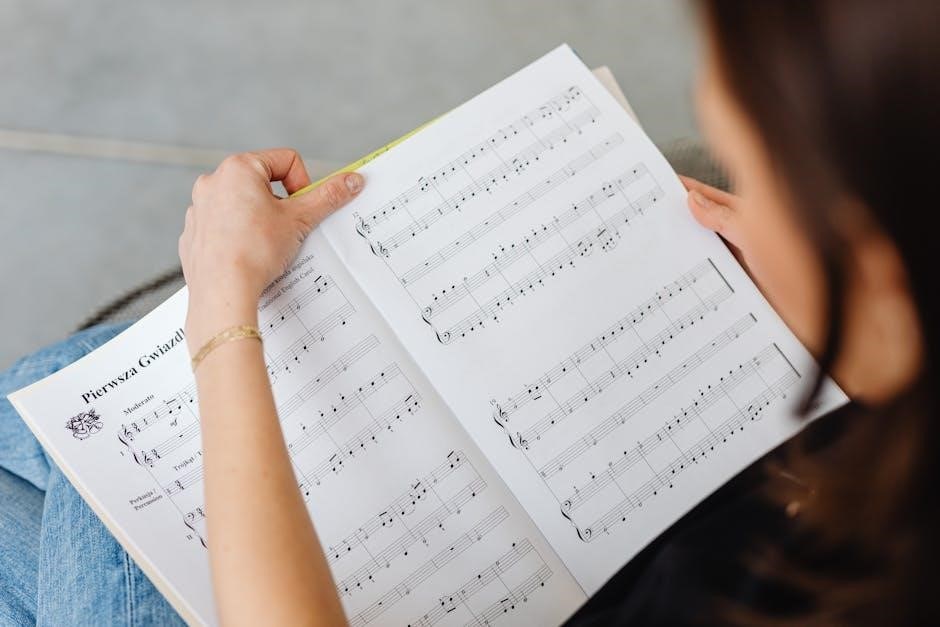
Identifying non-chord tones requires analyzing the melody against the harmonic progression. Understanding their function clarifies how they contribute to the overall musical effect. Recognizing these embellishments is crucial for accurate musical analysis and demonstrates a sophisticated understanding of compositional techniques.
XVII. Modulation
Modulation is the process of changing from one key to another within a piece of music, creating harmonic variety and interest. This shift isn’t abrupt; composers often use common chords or pivot chords – chords existing in both keys – to smoothly transition. Closely related keys, those differing by only one accidental, are frequently targeted for modulation.

Recognizing modulation involves identifying the new key signature and tonic. Analyzing the harmonic progression reveals the techniques employed for the key change. Understanding modulation demonstrates a grasp of harmonic function and compositional structure, vital for AP Music Theory success.
XVIII. Form and Analysis
Musical form refers to the overall structure of a composition, providing a blueprint for how musical ideas are organized. Common forms include binary (AB), ternary (ABA), rondo (ABACA), and sonata form (exposition, development, recapitulation). Analyzing form involves identifying sections, recognizing thematic material, and understanding how these elements contribute to the piece’s overall coherence.
The ability to analyze harmonic rhythm, phrase structure, and cadences is crucial for form analysis. Recognizing patterns and variations within a piece demonstrates a deep understanding of musical architecture, a key skill assessed on the AP Music Theory exam.